
Mahlatse Danny Masola


SELF-ASSERTIVENESS
I have always been a reserved, quiet, shy, and calm individual, these Characteristics was confirmed by individuals who completed my Johari Windows questionnaire. In addition, I consider myself as an introvert and feel more comfortable in smaller group settings. However, I used to fear confrontation and uncomfortable situations. During my second year as an HSS student, I became aware of the dangers of suppressing my own views and opinions due to fear of confrontation and uncomfortable situations. This was highlighted when we were required to complete a group presentation in YOS 2. My major contributor to unhappiness and dissatisfaction was as a result of my voice not being heard. To combat this, I began to stand up for my views and beliefs by subtly offering counterarguments or alternative views to notions being brought to light with the Integrative literature review.
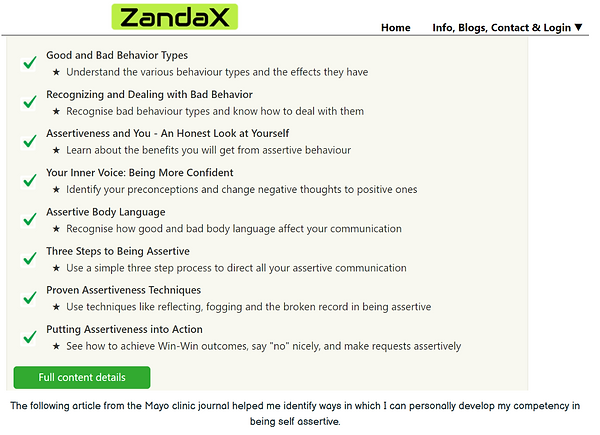
Upon conducting research on ways to improve my competency in being self-assertive, I came across an assertive training course that is conducted by ZandaX online. Despite having a US base, this course can be accessed from South Africa because it is online. The artefact below demonstrates how I will improve my self-assertiveness competency so that it changes from a weakness to a strength.
-
Assess your style. Do you express your opinions out loud or keep quiet? Do you accept new tasks even when your plate is already full? Are you quick to judge or blame? Do people seem to dread or fear talking to you? Before you start making changes, recognise your own personal style.
-
Keep emotions in check. Most people find conflict challenging. You can feel disappointed or furious, or you might even want to cry. Although these emotions are common, they may prevent conflicts from being resolved. If you can, wait a little if you enter a scenario where you feel very emotional. Then practise remaining composed. Breathe gradually. Be consistent and forceful in your speech.
-
Use 'I' statements. By using "I" statements, you may convey your thoughts and feelings to people without coming off as accusing. Say "I disagree," as opposed to "You're incorrect," as an example. Say "I would want you to help with this" rather than "You need to do this" when making a request. Keep your demands concise and detailed.
-
Practice saying no. Try stating "No, I can't do it now" if you have trouble saying no to requests. Don't think twice; just say it. If an explanation is necessary, keep it to a minimum.
-
Rehearse what you want to say. If expressing your thoughts or desires is difficult, prepare for common circumstances that you may experience. Declare your thoughts aloud. To practise from a script, it can be helpful to write it out first. Think about acting out a scenario with a friend or coworker and get specific feedback.


Accepting constructive criticism
To further develop my competency in accepting constructive criticism I have been using blog posts from varsity tutors. The post offers tips that you can continuously practice and exercise. The tips are as follows:
-
Be open to change
Being flexible will let you discover ideas you hadn't previously considered. Deconstructing a project, discarding out some components, starting over, taking a radically new approach within your work, and receiving constructive criticism in a way that inspires you to understand the full potential of your work are all examples of being open to change. By taking the risk of attempting something new, you may discover something you hadn't previously considered.
2. Plan action steps
Receiving criticism may be demoralising, therefore it's crucial to consider it by writing freely, speaking with peers, or seeking advice from professors. Using the input, one should create a strategy and divide complicated actions into smaller, more achievable activities. When obtaining opposing opinions, it's critical to analyse the information and move on with what's crucial for the project.
3. Don’t be afraid to ask questions
I've come to learn that I am a highly perceptive person when it comes to tone, attitude, and body language, therefore when I get criticism from others, it frequently gets misinterpreted. To address this, I asked questions to both comprehend my colleague's perspective and to explain any issues that might not have been clear.
-
“What do you mean by this?”
-
“I’m confused by… can you clarify?”
-
“What are you trying to convey here?”
4. Tailor feedback to the context
When receiving feedback, I need to remember to keep the larger context in mind. I need to remember that it is criticism of a project or piece of work and not on my character or competency. I always need to remind myself of the desired outcome, as well as appropriate etiquette for this context.
The discomfort of constructive criticism can often stymie a project or lead you to avoid any instances that involve it altogether. Thinking of it as an opportunity to reinvigorate your work is a great way to receive feedback. Don’t forget—giving feedback also develops your own critical perspective that you can apply to your own work.


NETWORKING
Action plan to improve networking skills
1. Get involved on campus
I feel that being engaged on campus has a variety of advantages. I know that for once, I will make friends, add college activity to my resume, and most importantly, expand my network. There are several options for me to get engaged on school, including honors societies, professional groups, employment, and student media. Not only will this strategy allow me to interact with a large number of other students, but it will also allow me to connect with speakers, advisers, and mentors. I'm expanding my network radius, and a great way to gain advice.
2. Be willing to actively listen.
I find this skill the most important yet not mentioned a lot in developing one's networking skills. I believe that if I'm not a good listener then I will not be a good communicator. Listening skill is essential as most people will be willing to listen to what I have to say when I give them an ear to listen to what they have to say. Actively listening will not only help me create conversations but will make me appear more thoughtful, empathetic and invested in those surrounding me, which is very essential for successful networking.
3. Build networking into my everyday routine
Ensure every week I sit next to someone on the bus and create light conversation to improve my communication skills. Engage in small conversations with my lecturers and classmates. One of the most effective strategies for me to develop my networking abilities is to exercise them on a daily basis. Attend networking events and concentrate on making true personal connections with those I meet. Ask questions that demonstrate my genuine desire to get to know the person with whom I'm conversing and listen carefully to the answer while maintaining eye contact. Respond with pertinent questions to demonstrate that I am paying attention. I would like to prioritize this quality of my interactions above the number.
4. Try to engage in various social media ways, and reply to other students’ discussion forums,
I'm not a fan of social media but what I know is that it is a great way to reach out to people and connect with them. For my professional development, I discovered that sites like LinkedIn are a very good way of expanding my network as it is a great addition to modern networking. Making it easier for companies to access CVs and a way to stand out in a crowd of applicants while sitting at home.
What I have done so far to improve my networking skills
1. Honoring Societal Invitations
These activities not only allowed me to continue learning, but they also taught me how to properly connect with people. It helped me gain contacts and health sciences knowledge that gave me a competitive advantage for when I will be choosing to further my studies in the health sciences field when choosing and applying to graduate programs, and getting a job.
2. Classmates and peers
I realized that at the beginning of the year, I was only including people who were further from me to improve my networking skills, and then one day it hit me. Networking is not limited to forming relationships with strangers but about strengthening relationships that are very close to you, the people I see and talk to every day might actually help me in practicing my networking skills. I was right!
Considering to build both my social and academic network with classmates/study peers Not only did it introduce me to new perspectives and experiences in my life, but it helped me find a lifelong friend in my classmates.
People networking can provide an opportunity to build mutually beneficial relationships with other students if approached correctly. Throughout the course, I've had the opportunity to collaborate with almost every student on a research project or a presentation. By far the last group surprised me by taking a picture to remember our previous presentation. Networking made me realize that having the right contacts in my professional network can help me maximize my opportunities for career growth and learning. The goal is to establish lines of communication and begin building relationships that are relevant to my work and career. Networking is about giving rather than taking. It is about building trust and assisting one another towards a common goal. I engage with my classmates on a regular basis and look for ways to help them strengthen their relationships. By doing so, I believe I have planted the seeds for reciprocal assistance when I need it to achieve my objectives in the future.
3. Get Togethers
These get-togethers made me realize that being visible and getting noticed is an important benefit of networking for career advancement. Attending professional, academic, and social events on a regular basis will help me make my presence known. Networking is a great way for me to learn about my peers' study and job-hunting techniques and stay up to date on the latest developments. For example, being near two other universities' students (UJ and UP) allowed me to get a glimpse of bursary opportunities and internships. A large network of knowledgeable, interconnected contacts means greater access to new and valuable information.
The ability to gather new information is an often-overlooked benefit of networking because it is not the most obvious, but it also provides opportunities for career advancement and development.
4. Random bus stop conversation
Talked to people in my field of interest (GEMP) – I recall waiting for the bus returning to my residence. We had just returned from the OLS museum on the main campus. When an alumnus from a different degree but the same faculty overheard my friend and I discussing sponsorships and GEMP, he approached us and spoke with us. We discussed our mutual experiences as health sciences students, his work, our schoolwork, and our experiences with leadership skills. This person then handed us his business card and offered us internship opportunities. This was not something we had requested or even anticipated. However, this interaction resulted from the realization that we enjoyed connecting.
“At its root networking is about connecting with someone on a different level. This may sound daunting but given time and practice may become enjoyable.”
How do I feel about these achievements?
As an active student on my campus and in my community, I've met many professionals in different fields. In just three short years, the opportunities that have come my way have allowed me to expand my social and professional circles twenty-fold. Networking can be awkward and frustrating, and it does help that some people are simply better equipped to interact with strangers and find ways to connect.
What I will do to ensure I achieve the remaining goals?
I will continue to look for something in common with the person with whom I find myself. This was the most common issue that I observed most of my peers and myself struggling with while conversing. I'm confident that by doing so, I will stand out by expressing genuine interest in them as a person and then letting the conversation flow. As a student, I believe this should be simple if I am in the presence of an alumni, particularly an HSS postgrad who went on the GEMP route. I have had the good fortune to form friendships with my classmates and medical students simply because we discovered that we (classmates and I) were both interested in pursuing a career in medicine.


